
Texas Title Policy Calculator
A $400,000 home purchase in Texas ($320,000 loan) costs $2,862 in premium and escrow fee with a traditional title policy, or $1,395 with an insured attorney opinion letter. That’s $1,467 less on the same house, before endorsements widen it further. Refinances add a third option, a GSE title waiver, which costs $950.
Most people only ever see the traditional option. This page walks through all three, plus the rate rules that decide what title costs. Run your own numbers in the calculator below.
Get an Instant Texas Title Cost Comparison
Loading the title fee calculator
Who’s this TX title insurance calculator for?
- Lenders and credit unions looking for a title partner with national coverage that handles volume, offers more than traditional title insurance, and gives LOs a real edge at the closing table.
- Loan officers who need a fast title number, and a second option when the borrower is tight on cash to close.
- Borrowers doing their own research on what title actually costs.
What does a Texas title policy quote include?
One naming note first, because it trips up anyone comparing across states: Texans say title policy where the rest of the country says title insurance. Same product. The standard Texas purchase contract from the Texas Real Estate Commission (TREC) calls it an “owner policy of title insurance” and then shortens it to “Title Policy” (TREC No. 20-18, paragraph 6A). This page uses both names.
Now the answer. The Texas premium covers more than the insurance itself. In the state’s own words, “the premium includes charges for additional services such as the title search, the title examination, and closing the transaction” (the Texas Department of Insurance’s title insurance FAQ; the underlying Rate Rule R-1 names the examination and the closing). The search and the exam are the records check: reading the property’s ownership history in the county records to find problems before you buy. So a Texas quote has no separate search line and no separate exam line. They’re already in the premium.
Here’s the part that genuinely confuses people: the premium includes “closing the transaction,” and yet every Texas quote also shows a separate escrow fee. The escrow fee is the title company’s own charge for the money side of the closing: collecting the funds, paying off the old loan, and disbursing to everyone owed. The state doesn’t set it. TDI says so directly: “You can shop around for cheaper escrow fees, or closing costs. These differ between agents.”
A few other things sit outside the premium too: endorsements and the per-policy guaranty fee, both explained in their own section below, plus the county’s charges for recording the deed and mortgage.
Most states split the bill differently. Florida also has state-set premiums, but its premium covers the insurance risk only, with the search, exam and closing billed as separate lines (Fla. Admin. Code 69O-186.003(11)). So a Texas quote and a Florida quote for the same premium dollar amount aren’t describing the same pile of work. Compare totals, not line counts.
Can you shop title insurance rates in Texas?
You can’t shop the premium. “All title companies will charge the same premium for a policy” (TDI FAQ). That’s not a marketing line. It’s how the state designed the system.
Who sets the Texas policy rates
The Texas insurance commissioner fixes the premium rates, and every title company must charge them (Tex. Ins. Code § 2703.151). Only two other states work this way, Florida and New Mexico. The current schedule took effect March 1, 2026.
County doesn’t move the number either. There’s one schedule for the whole state, so a $400,000 purchase carries the same premium in Dallas, Houston, San Antonio, and the smallest county in Texas.
Which means collecting three quotes to compare premiums is a waste of an afternoon. Comparing their escrow fees is a different story.
What you can compare instead
Three things actually vary:
- The escrow fee. It’s the one meaningful charge on the title side that the state doesn’t set. Link Title’s is $500 on a purchase and $450 on a refinance.
- The service. Most title searches turn up nothing. Some turn up a problem: an old lien nobody released, a misspelled name on a past deed, a gap in the chain of ownership. What separates title companies is whether they find the problem in week one or week four, and whether they fix it themselves or hand it off. Link Title finishes most title orders in 48 to 72 hours, and 99.7% of our searches are right the first time. When one isn’t, our own curative team fixes it rather than passing it to an outside firm.
- The product. Title insurance isn’t the only way to protect a Texas closing anymore, and the premium rules above only apply to title insurance.
What are the alternatives to a Texas title policy?
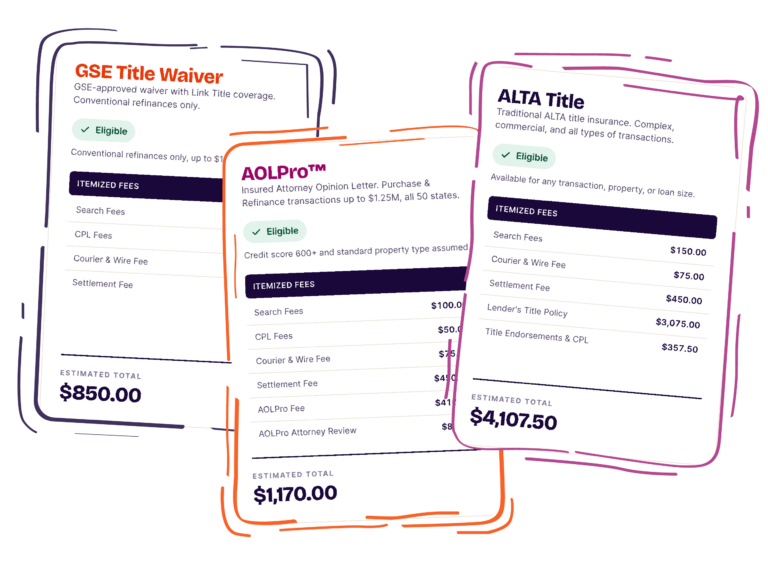
This calculator prices three products every time you run it:
- ALTA Title. Traditional title insurance. Any transaction, any property or loan size. The only option for complex and commercial transactions.
- AOLPro™. An insured attorney opinion letter that covers both the lender and the owner. Purchases and refinances up to $1.25M, all 50 states, credit score 600+.
- GSE Title Waiver. Conventional refinances up to $1.25M, meaning loans Fannie Mae or Freddie Mac will buy, not FHA or VA. No title policy is issued. The work still happens: Link Title still searches and examines the title. What gets waived is the policy itself. (GSE stands for government-sponsored enterprise, which is what Fannie and Freddie are.)
All three show up side by side with every fee itemized.
Are these title alternatives safe?
Fair question, especially in a state where the title policy is practically a fixture of the contract. Lenders don’t accept alternatives on faith: Fannie Mae authorizes lenders to use an attorney title opinion letter in place of a title insurance policy when its conditions are met, and your lender reviews and approves any alternative before it goes on the loan. If it didn’t protect the loan, they wouldn’t accept it.
How much does an attorney opinion letter cost in Texas?
On the $400,000 purchase with a $320,000 loan, AOLPro costs $1,395, everything included. The traditional route on the same purchase is $2,862 before endorsements: the $2,362 premium plus the $500 escrow fee.
AOLPro prices in brackets based on the loan amount, or on the purchase price when there’s no loan. The brackets step up gently: $1,295 up to a $200,000 loan, $1,395 to $400,000, $1,620 to $600,000, on up to $2,215 at the $1.25M cap. The table further down shows how the gap against the traditional route changes with the price.
The comparison is worth running early, at pre-qualification, while there’s still time to choose the product. Cash to close is often the number that stalls a deal, and title is one of the few charges in that total that can actually come down.
One Texas nuance about who pockets the difference: on a purchase, the saving lands on whoever the contract assigns each cost to, and in Texas the seller commonly pays for the owner’s policy. On a refinance there’s no seller, so the whole title bill, and the whole saving, is the borrower’s.
One loan officer who ran the comparison:
“I saved my borrower $1,447.95 and now I compare every single closing.” (Sue Maki, Branch Manager, Fairway Independent Mortgage, on a Texas refinance)
AOLPro and traditional title insurance aren’t identical in what they cover. The differences are narrow but real. Alita Group’s side-by-side comparison lays them out, and Bradley Arant’s commentary walks through the mechanics.
How much does an owner’s title policy cost in Texas?
It costs less than the quote makes it look. On the $400,000 purchase, the owner’s policy shows as $2,262 and the loan policy as $100. But that’s not what declining the owner’s policy would save you.
Here’s why. When both policies are issued together on the same land, Texas prices the owner’s policy at the full rate and the loan policy at a flat $100, called the simultaneous issue rate (Rate Rule R-5). Take the owner’s policy away and the $100 deal disappears with it. TDI puts it plainly: “If you decide not to purchase an owner’s policy, you will pay full price for the loan policy.” On this example, full price for a $320,000 loan policy is $1,867.
So the real cost of the owner’s policy is the difference:
|
Policy |
Amount |
|---|---|
|
Both policies together (owner’s $2,262 + loan $100) |
$2,362 |
|
Loan policy alone, at full price |
$1,867 |
|
What the owner’s policy actually adds |
$495 |
Declining the owner’s policy saves $495 and gives up every dollar of protection on the ownership side, on a policy that stays in force for as long as you own the home. The owner’s policy is also written for the full sales price: the TREC contract sets the amount at the Sales Price by its own terms (paragraph 6A).
With AOLPro there’s no such decision. The letter covers the lender and the owner under one fee, so nobody reaches closing without ownership coverage.
Who pays for the title policy in Texas?
Usually the seller pays, and that surprises people from other states. The TREC contract has a checkbox for it: “Seller shall furnish to Buyer at ☐ Seller’s ☐ Buyer’s expense an owner policy of title insurance” (paragraph 6A). Custom in most Texas markets is to check the seller’s box, but it’s literally a checkbox, so it’s negotiated with everything else in the offer.
The rest of the title bill has its own custom, also written into the contract (paragraph 12A): the buyer pays for the loan policy and the endorsements the lender requires, and the escrow fee splits half and half between seller and buyer.
What are the current Texas title policy rates?
The current schedule is effective March 1, 2026 (TDI, Texas Title Insurance Premium Rates). It has two parts. Either way, the policy amount you look up is the sales price for an owner’s policy and the loan amount for a loan policy.
Up to $100,000, the premium comes from a lookup table in $500 steps. A few anchors:
|
Policy amount |
Premium |
|---|---|
|
$25,000 (the minimum) |
$308 |
|
$50,000 |
$465 |
|
$75,000 |
$625 |
|
$100,000 |
$780 |
Over $100,000, the premium comes from a formula. Find your row in the table below, subtract that row’s “Subtract” figure from the policy amount, multiply the result by the “Multiply by” figure, round to the nearest dollar, then add the “Add” figure.
|
Policy range |
Subtract |
Multiply by |
Add |
|---|---|---|---|
|
$100,001 to $1,000,000 |
$100,000 |
0.00494 |
$780 |
|
$1,000,001 to $5,000,000 |
$1,000,000 |
0.00406 |
$5,226 |
|
$5,000,001 to $15,000,000 |
$5,000,000 |
0.00335 |
$21,466 |
|
$15,000,001 to $25,000,000 |
$15,000,000 |
0.00238 |
$54,966 |
|
$25,000,001 to $50,000,000 |
$25,000,000 |
0.00143 |
$78,766 |
|
$50,000,001 to $100,000,000 |
$50,000,000 |
0.00129 |
$114,516 |
|
Over $100,000,000 |
$100,000,000 |
0.00116 |
$179,016 |
In practice that first bracket is the whole story for residential Texas: about $4.94 per $1,000 above the $780 base.
Texas title policy endorsements
Endorsements are add-ons to a policy, each covering a specific risk the standard policy leaves out. Their prices are state-set, just like the premium. What isn’t standard is the list: two Texas quotes for the same house can show different endorsement lines, because the buyer pays for “endorsements required by lender” (TREC paragraph 12A) and lenders’ requirements differ, while the owner’s side has optional add-ons of its own. Some quotes assume two endorsements, some assume six. That’s a quoting assumption, not a price difference.
A note on the percentages below: several charges are a percentage of a policy’s basic rate, meaning the full premium the rate table above gives for that policy amount. On the $400,000 example, the owner’s policy’s basic rate is $2,262 and the loan policy’s is $1,867, even though the loan policy itself only costs $100 when issued simultaneously.
Here’s the set that shows up on Texas residential loan quotes, what each one is, and what it costs on the $400,000 purchase example ($320,000 loan):
|
Endorsement |
What it covers, in short |
State-set charge |
On this example |
|---|---|---|---|
|
T-19 |
Deed restrictions, structures crossing a boundary line, and mineral-rights issues, for the lender |
5% of the loan policy’s basic rate, minimum $50 (R-29) |
$93.35 |
|
T-19.1 |
The same coverage, for the owner |
10% of the owner’s policy’s basic rate, or 5% if the survey amendment below is also bought, minimum $50 (R-29) |
$226.20, or $113.10 with the survey amendment |
|
Survey amendment (owner’s policy) |
Removes the standard policy’s exclusion for boundary and survey problems, except the lot turning out smaller than described. Often called the “survey deletion” |
5% of the basic rate, minimum $20; free on the loan policy (R-16) |
$113.10 |
|
T-30 |
Rollback taxes: back taxes that can hit land that had an agricultural valuation |
$20 (R-19) |
$20 |
|
T-36 |
Environmental cleanup liens recorded against the property, for the lender |
$25 (R-11) |
$25 |
|
T-17 |
Homes in a planned unit development, covering the lender around the development’s restrictions and unpaid assessments |
$25 (R-11) |
$25 |
|
R-24 tax language |
Adds the insurer’s promise that this year’s property taxes and similar charges “are not yet due and payable” |
$5 (R-24) |
$5 |
One more charge appears with every policy and isn’t an endorsement at all: the Policy Guaranty Fee, collected for the Texas Title Insurance Guaranty Association, the state fund that covers policyholders if a title company or agent fails financially. It’s $2 per policy, and $3 for closings after September 30, 2026, so a quote closing this fall already shows $3.
The move: when two Texas quotes differ, don’t ask why one company is “cheaper.” Ask which endorsements each quote assumed, then ask your lender which ones your loan actually requires.
How to calculate a Texas title policy premium
Texas publishes the method, so you can check any quote yourself. Here’s the $400,000 owner’s policy worked through TDI’s own four steps:
|
Step |
What you do |
Result |
|---|---|---|
|
1 |
Find the bracket for $400,000 |
$100,001 to $1,000,000 |
|
2 |
Subtract $100,000 |
$300,000 |
|
3 |
Multiply by 0.00494 and round to the nearest dollar |
$1,482 |
|
4 |
Add $780 |
$2,262 |
On a purchase with a loan, add the flat $100 for the loan policy issued at the same time, for $2,362 all in on the premium side.
The calculator above does all of this, including the parts that vary by transaction. The worked steps are here so you can check any quote by hand.
The refinance discount (Rate Rule R-8)
If you refinance within a few years, Texas cuts the premium on the new loan policy, and the discount runs on a clock (Rate Rule R-8):
- Existing loan policy 4 years old or less: the credit is 50% of the basic premium on your current loan’s payoff balance (or its original amount, whichever is less).
- More than 4 but less than 8 years: the credit drops to 25%.
- 8 years or more: no credit. Full rate.
Worked example: a new $400,000 loan, refinancing a loan with a $380,000 payoff and a 3-year-old policy. The new policy’s basic premium is $2,262. The credit is 50% of the basic premium on $380,000, which is 50% of $2,163 (the rate formula’s premium for a $380,000 policy), so $1,081.50. The new premium: $1,180.50 instead of $2,262.
The condition: your current loan has to have been insured by a loan policy, which it almost certainly was if you bought or refinanced through a Texas title company. The move: tell your title company how old your current loan is and ask for the R-8 credit by name.
Texas title policy cost by purchase price
The ALTA column shows the premium plus Link Title’s escrow fee, before endorsements. The AOLPro column is all-in.
|
Transaction |
ALTA premium + escrow fee |
AOLPro™ |
GSE Waiver |
|---|---|---|---|
|
$200,000 purchase, $160,000 loan |
$1,874 |
$1,295 |
Not eligible |
|
$400,000 purchase, $320,000 loan |
$2,862 |
$1,395 |
Not eligible |
|
$600,000 purchase, $480,000 loan |
$3,850 |
$1,620 |
Not eligible |
|
$800,000 purchase, $640,000 loan |
$4,838 |
$1,820 |
Not eligible |
|
$400,000 refinance |
$2,712 |
$1,170 |
$950 |
The ALTA premium rises about $4.94 with every $1,000 of price. AOLPro moves in brackets based on the loan amount, holding steady across a range and then stepping up. That’s why the gap grows down the table: $579 on the first row, $3,018 on the fourth.
The waiver only applies to conventional refinances, which is why the purchase rows say Not eligible. And the refinance row shows the full basic rate: if you qualify for the R-8 credit above, the ALTA figure drops further.
What can you change about title costs in Texas?
You can’t change the premium: the state sets it and every company charges it. What’s yours to choose is everything around it. The product: on the $400,000 purchase, AOLPro at $1,395 sits $1,467 below the traditional premium-plus-escrow figure of $2,862, and that difference goes to whichever side of the contract was paying those costs. The R-8 credit on a refinance, which is real money and routinely goes unclaimed. The escrow fee, the one title charge the state leaves to the market. And who pays for what, which in Texas is a contract checkbox, not a law.
Run your numbers above. Then place the order when you’re ready.
Closing outside Texas?
The national title insurance calculator prices every state Link Title is licensed in.
Frequently Asked Questions
On a $400,000 purchase, the premium is $2,362 total: the owner’s policy carries the rate and the loan policy adds $100 at the simultaneous issue rate. That number is set by the state and identical at every title company. On top of it come the escrow fee (varies by company), endorsements, and recording fees.
Usually the seller pays for the owner’s policy, but it’s a checkbox in the TREC contract, so it’s negotiable. The loan policy and the lender’s endorsement list sit on the buyer’s side, and the two parties usually split the escrow fee down the middle.
Your lender requires title protection on any financed transaction. Traditionally that means a loan policy, though some lenders now accept an insured attorney opinion letter instead, and eligible conventional refinances can waive the policy entirely (both are covered above). The owner’s policy isn’t required by any law, but the standard Texas purchase contract provides one by default, and skipping it means paying full price for the loan policy instead of the $100 simultaneous rate.
It’s the Texas name for title insurance. The owner’s policy protects your ownership of the home and lasts as long as you own it. The loan policy protects the lender’s lien and ends when that loan is paid off.
Yes. If your current loan’s policy is 4 years old or less, the new loan policy’s premium is reduced by half the basic premium on your payoff balance. More than 4 but less than 8 years, a quarter. Mention Rate Rule R-8 when you order title.
March 1, 2026. The Texas Department of Insurance publishes the schedule, and this page’s tables and calculator use those rates.