
Florida Title Insurance Calculator
A $400,000 home purchase in Florida ($320,000 loan) costs $3,110 in title and settlement fees with a traditional title insurance policy, or $1,395 with an insured attorney opinion letter. That’s $1,715 less on the same house. Refinances add a third option, a GSE title waiver, which costs $850.
Most people only ever see the traditional option. This page walks through all three, plus the rate rules that decide what title costs. Run your own numbers in the Florida title insurance calculator below.
Get an Instant Florida Title Cost Comparison
Loading the title fee calculator
Who’s this Florida title insurance calculator for?
- Lenders and credit unions looking for a title partner with national coverage that handles volume, offers more than traditional title insurance, and gives LOs a real edge at the closing table.
- Loan officers who need a fast title number, and a second option when the borrower is tight on cash to close.
- Borrowers doing their own research on what title actually costs.
What does a Florida title insurance quote include?
Only part of the total, and that’s by design. Florida sets the title insurance premium itself, but the premium covers only the insurance risk. The title search (the check of public records for anything attached to the property), the examination (reading what the search turns up), and the closing each appear as their own line item, and the rule requires each to be charged at no less than its actual cost (Fla. Admin. Code r. 69O-186.003(11)).
Some states work the opposite way. Pennsylvania folds the search, examination, and settlement into one combined charge as a matter of law (40 P.S. § 910-1(5)). So a five-line Florida quote isn’t more expensive than a one-line Pennsylvania quote. It’s the same work, itemized instead of bundled. Compare totals, not first lines.
Endorsements are on the quote too, priced under their own rule (more on those below). You’ll also see documentary stamp taxes and intangible tax on a Florida closing statement. Those are state taxes collected at closing, not title charges, and no title company controls them.
Can you shop title insurance rates in Florida?
Not on the premium, and it’s worth understanding why.
Who regulates title insurance rates?
Florida is one of only three states, with Texas and New Mexico, where the state itself sets the title premium. The legal term is a promulgated rate: the state writes the number, and every title company must charge it. The Legislature requires the premium to be set by state rule (Fla. Stat. § 627.782), and the adopted schedule applies throughout the state. The premium for a $400,000 policy is the same at every title company in Florida, in every county, from Pensacola to Key West.
Which means collecting three quotes to compare premiums won’t change much.
So what can you compare?
Plenty. Florida fixes the premium and the endorsement charges, but three things vary:
- The service charges. Each title company sets its own fees for the search, the examination, and the closing, so those three numbers change from quote to quote even though the premium never does. When you compare quotes, compare those three fees.
- Whether the discounts you qualify for get applied. Florida’s reissue rate can cut a refinance premium sharply, but it only gets applied when your old owner’s policy makes it into the title company’s file. The rates section below walks through it.
- Speed, and what happens when the search finds a problem. An old mortgage never marked paid, a contractor’s lien, a misspelled name on a past deed: it has to be sorted out before closing. Link Title finishes most files in 48 to 72 hours, and 99.7% of our searches are right the first time. When one isn’t, our own curative team fixes it instead of handing it to an outside firm, which is what usually adds days.
The other thing you can compare is the product itself. Title insurance isn’t the only option anymore.
What are the alternatives to title insurance in Florida?
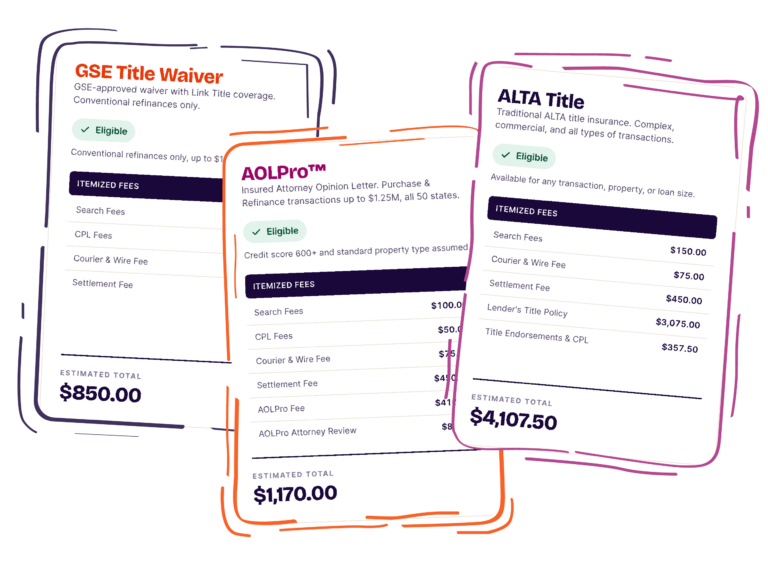
This Florida title insurance calculator prices three products every time you run it:
- ALTA Title. Traditional title insurance (ALTA is the American Land Title Association, whose policy forms the industry uses). Any transaction, any property or loan size. The only option for complex and commercial transactions.
- AOLPro™. An insured attorney opinion letter that covers both the lender and the owner. Purchases and refinances up to $1.25M, all 50 states, credit score 600+.
- GSE Title Waiver. Conventional refinances up to $1.25M, meaning loans Fannie Mae or Freddie Mac will buy, not FHA or VA. No title insurance policy is issued. (GSE stands for government-sponsored enterprise, which is what Fannie and Freddie are.)
All three show up side by side with every fee itemized. The lender makes the final call on eligibility, but the comparison takes no title expertise to read.
Are title insurance alternatives safe?
This is a fair question, especially if you’re seeing these products for the first time.
Start with one fact: the title insurance a lender requires protects the lender, not the buyer. The lender’s policy protects the loan. The policy that protects the buyer’s ownership is a separate, optional purchase called the owner’s policy.
Lenders don’t accept alternatives on faith. Fannie Mae authorizes lenders to use an attorney title opinion letter in place of a title insurance policy when Fannie Mae’s conditions are met. Your lender reviews and approves any alternative before it’s used on your loan. If it didn’t protect the loan, they wouldn’t accept it.
How the GSE title waiver works: The word “waiver” throws people, because it sounds like the work gets skipped. It doesn’t. Link Title still runs the search, still examines the title, still handles the closing. What gets waived is the policy. What protects the lender instead is its agreement with Fannie Mae or Freddie Mac: on eligible loans, the GSE accepts the title report, and any title problem that surfaces later is worked out under that agreement between the lender and the GSE instead of through an insurance company. And a refinance never issues a new owner’s policy, so there’s no ownership coverage to lose.
How AOLPro works: AOLPro is backed by an insurance policy, and that policy is written to include the cost of the legal defense. If someone challenges your ownership, the insurer pays for the lawyer and fights the claim, on top of covering any loss.
How much does an attorney opinion letter cost?
On the $400,000 purchase, the traditional route totals $3,110 on the Closing Disclosure: the promulgated premium, the endorsements, and the search, settlement, and courier charges. The same purchase through AOLPro totals $1,395, a difference of $1,715.
That matters because cash to close is often the number that stalls a deal. The rate and the monthly payment get most of the attention, but the buyer also needs the down payment, lender charges, prepaids, escrow funding, and title and settlement fees sitting in their account on closing day. A buyer who qualifies for the monthly payment can still come up short on that sum.
One Florida wrinkle: who actually pays those title fees is set by the purchase contract, and in much of the state the custom is that the seller pays for the owner’s policy. The who-pays section below covers it. Whichever side pays, the fees are part of the deal, and the comparison is worth running early, at pre-qualification, while there’s still time to choose the product.
AOLPro and traditional title insurance aren’t identical in what they cover. The differences are narrow but real. Alita Group’s side-by-side comparison lays them out, and Bradley Arant’s commentary walks through the mechanics.
How much does owner’s title insurance cost in Florida?
On the $400,000 purchase, the owner’s policy is $2,075. But keeping it effectively costs $425, and here’s the math behind that.
In Florida the owner’s policy is issued for the full purchase price, which is where the $2,075 comes from. The lender’s policy issued at the same time then costs $25. Why so little? Under the simultaneous issue rule (r. 69O-186.003(5)), when both policies close together, the lender’s policy costs a $25 minimum as long as it doesn’t exceed the owner’s policy amount. Buy that protection on its own and the lender’s policy would run $1,675 on the $320,000 loan.
|
Amount |
|
|---|---|
|
Owner’s policy ($400,000) + lender’s policy together |
$2,100.00 |
|
Lender’s policy alone ($320,000, full schedule) |
$1,675.00 |
|
What keeping the owner’s policy really costs |
$425.00 |
The lender’s policy is the required one, and it protects the lender. Florida takes the buyer’s side of that seriously: a buyer who takes a lender’s policy without an owner’s policy signs a state-approved notice acknowledging the lender’s policy doesn’t protect them (Fla. Stat. § 627.798, form adopted by rule 69O-186.002). At $425 for full ownership protection on a $400,000 house, you’d struggle to find anyone in the business who’d advise signing it.
With AOLPro there’s no such decision. The letter covers the lender and the owner under one fee, so there’s no second policy to buy and no notice to sign.
Who pays for title insurance in Florida?
No Florida law assigns the cost. The purchase contract decides, and the standard Florida Realtors/Florida Bar contract makes it an explicit checkbox: the seller pays for the owner’s policy and picks the title company that handles the closing, or the buyer does. Across most of the state, custom checks the seller’s box. In Miami-Dade and Broward the custom flips, and the contract carries a dedicated regional provision for exactly those two counties, with the buyer paying for their own policies.
Two things hold everywhere: it’s negotiable, and the lender’s policy and the other charges on the buyer’s loan stay with the buyer. Check the contract before assuming either way.
Current Florida title insurance rates
Here’s the promulgated schedule, adopted by rule 69O-186.003 and in effect since July 1, 2002. Owner’s and lender’s policies use the same table.
|
Amount of insurance |
Rate per $1,000 |
|---|---|
|
First $100,000 |
$5.75 |
|
$100,000 up to $1 million |
$5.00 |
|
Over $1M up to $5M |
$2.50 |
|
Over $5M up to $10M |
$2.25 |
|
Over $10M |
$2.00 |
The minimum premium is $100. Amounts don’t round to the next $1,000: Florida works in $100 steps, so the premium on a $253,450 policy is worked out as if the amount were $253,500.
The reissue rate on refinances
If you’re refinancing a home you bought with an owner’s policy, a cheaper table applies:
|
Amount of insurance |
Reissue rate per $1,000 |
|---|---|
|
First $100,000 |
$3.30 |
|
$100,000 up to $1 million |
$3.00 |
|
Over $1M up to $10M |
$2.00 |
|
Over $10M |
$1.50 |
On a $400,000 refinance, if your prior owner’s policy covers at least the new loan amount, the premium is $1,230 instead of $2,075. That’s $845 lower on the premium alone, and a little more at closing, because the Form 9 endorsement (covered below) is priced as a percentage of the premium and shrinks with it. There’s no time limit on this for refinances. You may read about a three-year limit: that belongs to a different case, reselling the home, not refinancing it.
Here’s the part worth knowing before you order. The Florida Department of Financial Services puts it plainly: “If a prior owner’s policy exists, reissue rates should be charged.” The rule makes the lower rate mandatory once two conditions are met: a prior owner’s policy insuring you, and a copy of it in the files of the title agent and the insurer behind the policy. But a Florida appeals court has also held that nobody is required to go searching for that policy on your behalf (Bleich v. Chicago Title, Fla. 3d DCA 2013). Federal reviewers have heard the same concern for years: regulators and industry officials told the Government Accountability Office that consumers may not be getting refinance discounts they’re eligible for (GAO-07-401), and participants in a 2024 Treasury roundtable raised it again.
So the move is simple: find the owner’s policy from your purchase closing and include it with your refinance order. That one document is what makes the lower rate mandatory. Send us yours and we apply the reissue rate it qualifies for.
Florida title endorsements
An endorsement is an add-on that expands what the policy covers, and lenders require specific ones. Florida sets those charges too, under rule 69O-186.005, and they must be itemized on the closing statement. The three on a typical Florida home loan:
|
Endorsement |
Charge |
|---|---|
|
ALTA 8.1, Environmental Protection Lien |
$25.00 minimum |
|
ALTA 5/5.1, Planned Unit Development (a home in an association-run community) |
$25.00 minimum |
|
Florida Form 9 (restrictions, easements, minerals) |
10% of the total policy premium, minimum |
Fannie Mae requires the ALTA 8.1 on every loan it buys, and the PUD endorsement when the home sits in one. Florida lenders routinely require Form 9 as well. On the $400,000 purchase, Form 9 is 10% of the combined $2,100 premium, so the three together add $260.
How to calculate Florida title insurance
The schedule works in bands, like tax brackets: each rate applies only to the dollars inside its own band. Here’s the $400,000 purchase worked all the way through. The Florida title insurance calculator above runs this math for you.
|
Band |
Dollars in it |
Rate |
Amount |
|---|---|---|---|
|
First $100,000 |
$100,000 |
$5.75 per $1,000 |
$575.00 |
|
$100,000 to $400,000 |
$300,000 |
$5.00 per $1,000 |
$1,500.00 |
|
Owner’s policy |
$2,075.00 |
||
|
Lender’s policy, issued simultaneously |
minimum |
$25.00 |
|
|
Endorsements (8.1, PUD, Form 9 at 10% of $2,100) |
$260.00 |
||
|
Search, settlement, courier |
$750.00 |
||
|
Total |
$3,110.00 |
One note on the $750 row: those are Link Title’s charges for the title search, the settlement (running the closing itself), and the courier. Florida doesn’t set them, so they’re the part of the bill that changes from one title company to the next. The $2,100 premium is the same at every company by law. So compare title quotes on their service charges, and judge each quote by its total: what you’d actually pay for title on this purchase is the full $3,110.
The calculator above does all of this, including the parts that vary by transaction. This is here so you can check it.
Florida title insurance fees by purchase price
|
Transaction |
ALTA Title |
AOLPro™ |
GSE Waiver |
|---|---|---|---|
|
$200,000 purchase, $160,000 loan |
$2,010.00 |
$1,295.00 |
Not eligible |
|
$400,000 purchase, $320,000 loan |
$3,110.00 |
$1,395.00 |
Not eligible |
|
$600,000 purchase, $480,000 loan |
$4,210.00 |
$1,620.00 |
Not eligible |
|
$800,000 purchase, $640,000 loan |
$5,310.00 |
$1,820.00 |
Not eligible |
|
$400,000 refinance |
$3,007.50 ($2,078.00 with the reissue rate) |
$1,170.00 |
$850.00 |
ALTA totals include the premium, the three standard endorsements, and search, settlement, and courier charges ($750 on purchases, $675 on refinances). The ALTA premium rises with the insured amount. AOLPro is priced in loan-size brackets, so it holds steady across a range and then steps up. That’s why the gap widens down the table, from $715 on the first row to $3,490 on the fourth. On the refinance row, the reissue rate saves $929.50 all-in: the $845 premium difference plus the Form 9 endorsement shrinking with it.
The waiver only applies to conventional refinances, which is why those rows say Not eligible.
What can you change about title costs in Florida?
Florida fixes the premium, but it doesn’t fix which title product the closing uses, whether your old owner’s policy gets sent in for the reissue rate, or the service charges around the premium. On the $400,000 purchase the product choice is worth $1,715. On a refinance, the reissue rate cuts the premium by $845, and the waiver brings the whole title bill to $850.
Run your numbers in the Florida title insurance calculator above. Then place the order when you’re ready.
Closing outside Florida?
The national title insurance calculator prices every state Link Title is licensed in.
Frequently Asked Questions
In Florida, the state-set premium covering both the owner’s and lender’s policies is $2,100. With endorsements and the search, settlement, and courier charges, the traditional total comes to $3,110. The same purchase through an insured attorney opinion letter totals $1,395.
Whoever the purchase contract says. The standard Florida contract makes it a checkbox, and custom fills it in differently by county: the seller pays for the owner’s policy in most of the state, while in Miami-Dade and Broward the buyer typically does. It’s negotiable everywhere.
No law requires it, but your lender requires its own policy on any financed transaction, so in practice a financed purchase carries at least a lender’s policy (unless the loan uses an approved alternative). The owner’s policy is your call, and skipping it means first signing a state-required notice that the lender’s policy doesn’t protect you.
It’s a lower state-set premium for refinances of a home you already hold an owner’s policy on: $1,230 instead of $2,075 on a $400,000 loan, when the old policy covers at least the new loan amount. It’s mandatory once that policy is on file with your title agent and the insurer, but nobody is required to hunt for it on your behalf. Send it in with your order.
Most Link Title files finish in 48 to 72 hours, and 99.7% of our searches are right the first time.