
PA Title Insurance Calculator
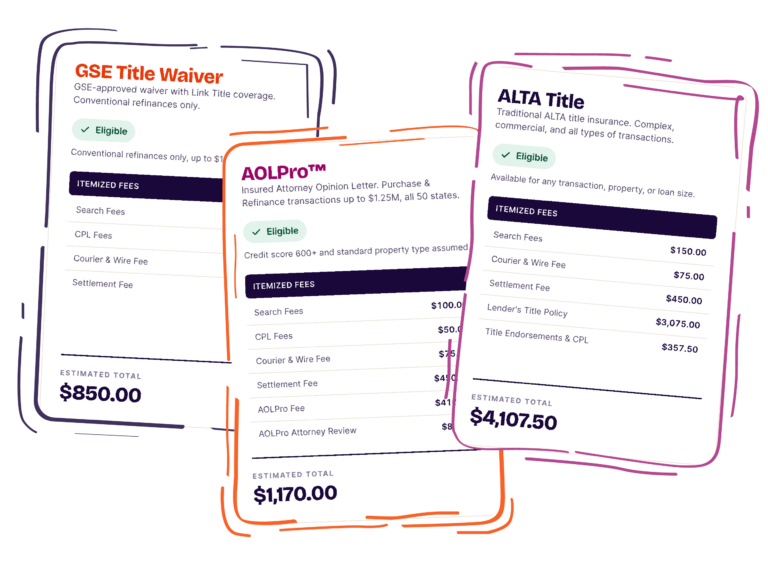
A $320,000 home purchase in Pennsylvania ($256,000 loan) costs $2,704 in title fees with a traditional title insurance policy, or $1,395 with an insured attorney opinion letter. That’s $1,309 less on the same house. Refinances add a third option, a GSE title waiver, which costs $850.
Most people only ever see the traditional option. This page walks through all three, plus the rate rules that decide what title costs. Run your own numbers in the calculator below.
Get an Instant PA Title Cost Comparison
Loading the title fee calculator
Who’s this PA title insurance calculator for?
- Lenders and credit unions looking for a title partner with national coverage that handles volume, offers more than traditional title insurance, and gives LOs a real edge at the closing table.
- Loan officers who need a fast title number, and a second option when the borrower is tight on cash to close.
- Borrowers doing their own research on what title actually costs.
What does a Pennsylvania title insurance quote include?
Pennsylvania is an all-inclusive rate state, and that’s a matter of law, not custom (40 P.S. § 910-1(5)). What does that mean exactly? Basically, one charge covers four things: the title search, the examination, the settlement or closing, and the insurance risk itself. The rating bureau spells that out. Most states don’t work this way. Virginia’s law does the opposite, keeping search, exam and closing costs out of the title insurance risk rate (Va. Code § 38.2-4608(C)).
So when a Pennsylvania quote shows $2,279, the search, the exam, and the closing are already included. A quote from another state showing $1,500 plus a separate $500 settlement fee plus a $175 search fee isn’t actually cheaper. It’s the same work, itemized differently.
Some things sit outside that number. The main two are title endorsements and the closing protection letter, which are flat charges adding $425 on a standard Pennsylvania residential loan. A few other charges can apply depending on the property, like tax certifications and municipal lien searches (§3.4).
Can you shop title insurance rates in Pennsylvania?
Almost every title company in Pennsylvania works from the same approved rate schedule, so the premium is nearly identical no matter who you call. A company can apply to charge something different, and a few do, but collecting three quotes to compare premiums won’t change much.
Who regulates title insurance rates?
Rates are set through the Title Insurance Rating Bureau of Pennsylvania, a nonprofit licensed by the Pennsylvania Insurance Department as a rating organization (40 P.S. § 910-41). The TIRBOP Rate Manual, which states that licensing authority as Section 741 of the Insurance Company Law of 1921, is filed with and approved by the Department, and it binds every title insurer and agency that prices through the bureau.
One honest caveat, because it gets misreported often: a company can apply to the Department for permission to charge something different, and get it approved. So Pennsylvania rates are near-uniform in practice, not identical by law. County doesn’t change the premium either. A $320,000 purchase costs exactly the same in Philadelphia as it does in Pittsburgh. Pennsylvania has no municipal or township component, unlike some neighboring states.
Which means collecting three quotes to compare premiums won’t change much.
So what can you compare?
You can compare service. Speed, and what happens when something goes wrong. Most searches turn up nothing. Some turn up a problem: an old mortgage paid off but never marked as paid, a contractor’s lien, a name spelled wrong on a past deed. That has to be sorted out before the sale can close, and what separates title companies is whether they find it in week one or week four, whether they fix it themselves or hand it to someone else, and whether anyone tells you it’s happening.
Link Title finishes most files in 48 to 72 hours, and 99.7% of our searches are right the first time. When one isn’t, our own curative team fixes it rather than passing it to an outside firm, which is what usually adds days.
The other thing you can compare is the product itself. Title insurance isn’t the only option anymore.
What are the alternatives to title insurance in PA?
This calculator prices three products every time you run it:
- ALTA Title. Traditional title insurance. Any transaction, any property or loan size. The only option for complex and commercial transactions.
- AOLPro™. An insured attorney opinion letter that covers both the lender and the owner. Purchases and refinances up to $1.25M, all 50 states, credit score 600+.
- GSE Title Waiver. Conventional refinances up to $1.25M, meaning loans Fannie Mae or Freddie Mac will buy, not FHA or VA. No title insurance policy is issued. (GSE stands for government-sponsored enterprise, which is what Fannie and Freddie are.)
All three show up side by side with every fee itemized. The lender makes the final call on eligibility, but the comparison takes no title expertise to read.
Are title insurance alternatives safe?
This is a fair question, especially if you’re seeing these products for the first time.
Start with one fact: the title insurance a lender requires protects the lender, not the buyer. The lender’s policy protects the loan. The policy that protects the buyer’s ownership is a separate, optional purchase called the owner’s policy.
Lenders don’t accept alternatives on faith. Fannie Mae authorizes lenders to use an attorney title opinion letter in place of a title insurance policy when its conditions are met. Your lender reviews and approves any alternative before it goes on the loan. If it didn’t protect the loan, they wouldn’t accept it.
To put it simply: if the lender accepts AOLPro or the waiver, the cheaper route is available. On a refinance there’s no owner’s policy either way, so nothing changes for the buyer. On a purchase, AOLPro covers the owner as well as the lender, so nobody gets dropped from the deal to save the money.
How the GSE title waiver works: The word “waiver” throws people, because it sounds like the work gets skipped. It doesn’t. Link Title still runs the search, still examines the title, still handles the closing. What gets waived is the policy. The title still gets validated, there’s just no insurance issued saying so, and nothing else is issued in its place. What protects the lender instead is its agreement with Fannie Mae or Freddie Mac, which accepts the title report on eligible loans and handles title risk under that agreement rather than through an insurer. And a refinance never involves an owner’s policy, so there’s no ownership coverage to lose.
How AOLPro works: The insurance behind it covers the lender and the owner, and it’s written to include the cost of the legal defense. If someone brings a claim against the ownership, the insurer pays for the lawyer and fights it, on top of covering the loss.
How much does an attorney opinion letter cost?
On the $320,000 purchase, the traditional title insurance route totals $2,704 on the Closing Disclosure. The same purchase through AOLPro totals $1,395, which is $1,309 less cash to close on the same house.
That matters because cash to close is often the number that stalls a deal. The rate and the monthly payment get most of the attention, but the buyer also needs the down payment, lender charges, prepaids, escrow funding, and title and settlement fees sitting in their account on closing day. A buyer who qualifies for the monthly payment can still come up short on that sum.
The gap widens as the numbers go up, and the examples table further down has the full spread. Either way, the comparison is worth running early, at pre-qualification, while there’s still time to choose the product.
AOLPro and traditional title insurance aren’t identical in what they cover. The differences are narrow but real. Alita Group’s side-by-side comparison lays them out, and Bradley Arant’s commentary walks through the mechanics.
How much does owner’s title insurance cost in PA?
It costs less than most people expect: $364.80 on the $320,000 purchase.
Why so little? Because the buyer isn’t paying for two policies. Pennsylvania charges for one, priced on the larger of the two amounts (§5.2 C). Cover the $256,000 loan and it’s $1,914.20. Cover the full $320,000 purchase instead and it’s $2,279.00. The owner’s policy is the difference:
|
Amount |
|
|---|---|
|
Lender’s title policy |
$1,914.20 |
|
Owner’s title policy (optional) |
$364.80 |
|
Both policies together |
$2,279.00 |
The lender’s policy is the required one, and it protects the lender. The owner’s policy is the buyer’s call. Pennsylvania asks only that a buyer who turns it down do so in writing (31 Pa. Code § 126.1).
At $364.80, though, you’d struggle to find anyone in the business who’d tell a buyer to skip it. Declining saves that amount and gives up every dollar of protection on the ownership side.
With AOLPro there’s no such decision. The letter covers the lender and the owner under one fee, so there’s no second policy to buy, no form to sign, and no way for a buyer to reach closing without ownership coverage.
Who pays for title insurance in PA?
By custom across most of Pennsylvania, the buyer pays for both policies. But that’s convention, not law. The Agreement of Sale decides, and it’s negotiable. Sellers do cover the owner’s policy in some deals, especially where the seller is already offering concessions.
The lender’s policy is always charged to the borrower, no matter who pays for the rest.
Current Pennsylvania title insurance rates
Here’s the current TIRBOP schedule, §5.50 of the Rate Manual as amended through 1 August 2024. These are the rates for a normal residential deal handled by a title company or its agent.
The table below has two rate columns, and the names don’t tell you much. Purchases use the Sale Rate. Refinances use the Non-Sale Rate, which is cheaper (§5.2 A and B).
|
Amount of insurance |
Sale Rate |
Non-Sale Rate |
|---|---|---|
|
$0 to $30,000 |
$569.00 |
$512.00 |
|
$30,001 to $45,000 |
add $7.41 per $1,000 |
add $5.98 per $1,000 |
|
$45,001 to $100,000 |
add $6.27 per $1,000 |
add $5.41 per $1,000 |
|
$100,001 to $500,000 |
add $5.70 per $1,000 |
add $4.84 per $1,000 |
|
$500,001 to $1,000,000 |
add $4.56 per $1,000 |
add $4.27 per $1,000 |
|
$1,000,001 to $2,000,000 |
add $3.42 per $1,000 |
add $3.13 per $1,000 |
|
$2,000,001 to $7,000,000 |
add $2.28 per $1,000 |
add $1.99 per $1,000 |
|
$7,000,001 to $30,000,000 |
add $1.71 per $1,000 |
add $1.71 per $1,000 |
|
$30,000,000 and above |
add $1.42 per $1,000 |
add $1.42 per $1,000 |
Amounts round up to the next $1,000.
Pennsylvania title endorsements
A standard Pennsylvania residential loan carries four flat charges totaling $425.00:
|
Item |
TIRBOP |
Charge |
|---|---|---|
|
Closing Protection Letter, single transaction |
§3.5 |
$125.00 |
|
PA 100, Covenants, Conditions and Restrictions |
§6.1 |
$100.00 |
|
PA 300, Survey Exception |
§6.6 |
$100.00 |
|
PA 900 (ALTA 8.1), Environmental Protection Lien |
§6.15 |
$100.00 |
All four are flat charges, so they don’t scale with the loan. The same $425 applies to a $200,000 purchase and a $392,000 refinance.
How to calculate PA title insurance
The rate table stacks like tax brackets. Each rate applies only to the dollars inside its own band, not to the whole purchase price. That trips people up, so here’s the $320,000 purchase worked all the way through at the Sale Rate.
|
Band |
Dollars in it |
Rate |
Amount |
|---|---|---|---|
|
First $30,000 |
$30,000 |
flat |
$569.00 |
|
$30,001 to $45,000 |
15 thousands |
$7.41 each |
$111.15 |
|
$45,001 to $100,000 |
55 thousands |
$6.27 each |
$344.85 |
|
$100,001 to $320,000 |
220 thousands |
$5.70 each |
$1,254.00 |
|
Premium |
$2,279.00 |
||
|
Endorsements and CPL |
$425.00 |
||
|
Total |
$2,704.00 |
Three things worth knowing before you run one by hand. Round the amount up to the next $1,000 before you start. The premium covers both policies together, not just the lender’s. And the endorsements are flat, so they don’t change with the price.
The calculator above does all of this, including the parts that vary by transaction. This is here so you can check it.
PA title insurance fees by purchase price
|
Transaction |
ALTA Title |
AOLPro™ |
GSE Waiver |
|---|---|---|---|
|
$200,000 purchase, $160,000 loan |
$2,020.00 |
$1,295.00 |
Not eligible |
|
$320,000 purchase, $256,000 loan |
$2,704.00 |
$1,395.00 |
Not eligible |
|
$500,000 purchase, $400,000 loan |
$3,730.00 |
$1,395.00 |
Not eligible |
|
$625,000 purchase, $500,000 loan |
$4,300.00 |
$1,620.00 |
Not eligible |
|
$392,000 refinance |
$2,737.53 |
$1,170.00 |
$850.00 |
The ALTA premium rises with every $1,000 of insured amount. AOLPro moves in brackets, so it holds steady across a range and then steps up: $1,295, then $1,395, then $1,620. That’s why the gap widens down the table, from $725 on the first row to $2,680 on the fourth.
The waiver only applies to conventional refinances, which is why those rows say Not eligible.
What can you change about title costs in Pennsylvania?
Pennsylvania fixes the premium, but it doesn’t fix which title product the closing uses or who handles it. On the $320,000 purchase that choice is worth $1,309, and on a refinance it’s often the largest movable line on the Closing Disclosure.
Run your numbers above. Then place the order when you’re ready.
Closing outside Pennsylvania?
The national title insurance calculator prices every state Link Title is licensed in.
Frequently Asked Questions
On a $320,000 purchase, total title and settlement fees come to $2,704: $2,279.00 in premium covering both the owner’s and lender’s policies, plus $425.00 in flat endorsements and the closing protection letter. Pennsylvania’s rate is all-inclusive, so the search, examination, and settlement are already inside that number.
Your lender requires its own policy on any financed transaction. That one isn’t optional.
No. It’s optional, and you have to turn it down in writing (31 Pa. Code § 126.1). But it costs less than most people expect. On a $320,000 purchase it adds $364.80, because Pennsylvania prices both policies as one. Declining saves that $364.80 and gives up all protection on the ownership side.
The lender’s policy insures a specific loan. When you refinance, the old loan is paid off and its policy ends with it, so the new loan needs its own coverage. Pennsylvania charges the lower Non-Sale Rate for it. An owner’s policy from your purchase is different: it stays in force for as long as you own the home and doesn’t need to be repurchased.
Link Title clears most files to close in 48 to 72 hours, and 99.7% of our searches are right the first time.